
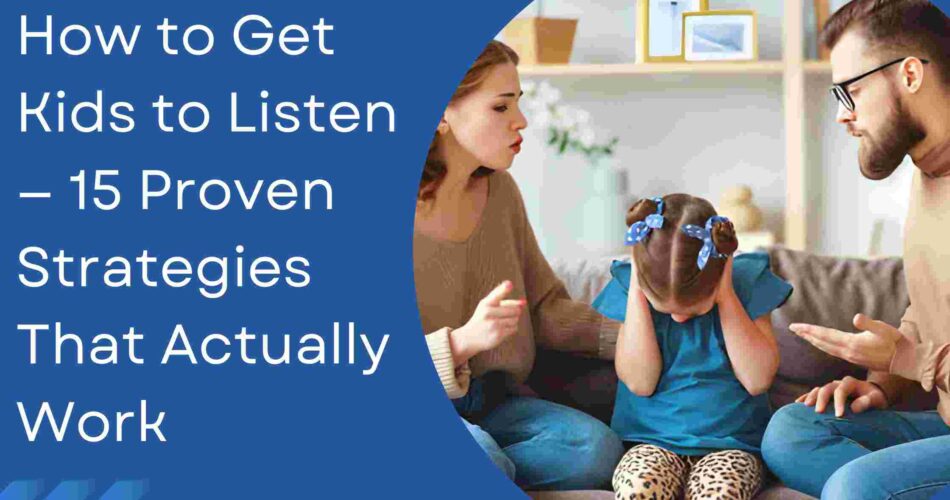
How to Get Kids to Listen — 15 Proven Strategies That Actually Work
Getting kids to listen can sometimes feel like trying to download a movie with bad network—slow, frustrating, and full of repeated attempts. You say one thing, they hear another. Or worse… they hear nothing at all.
Children aren’t born good listeners—listening is a skill they learn over time. And as parents and caregivers, we can help them build that skill in a respectful, effective, loving way—without yelling, nagging, bribing, or power struggles.
But here’s the truth many parents don’t realize: kids want to listen. They just need the right environment, the right approach, and the right kind of communication that matches how their brains work.
In today’s distraction-filled world, getting your child’s attention isn’t about shouting louder or repeating yourself endlessly. It’s about using smarter, proven strategies that make listening natural—not forced.
Whether you’re dealing with a toddler who says “no” on repeat or a school-age child who suddenly develops “selective hearing,” these 15 research-backed tips will help you connect, communicate, and actually get results.
Get ready—your home is about to get a whole lot calmer. Let’s get started.

Why Kids Don’t Listen (Even When They Can Hear You)
If your child seems like a “non-listener, the first step is to rule out actual hearing in issues. You can book a check-up… or simply whisper, “Who wants ice cream?” from the next room. If they jump up screaming “ME!”, then hearing isn’t the problem.
So if they can hear—why don’t they listen?
Listening isn’t just about sound. It’s about attention, motivation, timing, capability, connection, and interest. Kids don’t always ignore us because they’re being naughty. Sometimes they’re tired, distracted, overwhelmed, overstimulated—or simply human, just like us.
Read this:
No Yelling, Just Results: Positive Discipline That Works
Raising Resilient Kids In An Overwhelming World
How to Get Kids to Listen — 15 Proven Strategies That Actually Work
Before we try to fix the problem, we need to understand it.
Children don’t ignore us just because they’re being “difficult.” They might be:
- Deeply focused on something important to *them* (play is serious business)
- Tired, hungry, overwhelmed, or distracted
- Unsure how to do what they’re told
- Feeling disconnected, stressed, or unheard
- Struggling with emotional regulation
- Not motivated—or simply not *interested*
- They don’t like being told what to do (sound familiar?)
- They don’t think it’s important
- They forgot (yes, actually forgot!)
- They can’t do it without help
- It feels unfair (Why me? Why not my sibling?)
So, when they don’t listen, it’s usually not about defiance. It’s about development, timing, capability, and connection.

When Compliance Matters
“Compliance” has become a dirty word in modern parenting. It often brings to mind rigid, authoritarian parenting. And yes, forcing children to obey blindly is not the goal.
But let’s be real—sometimes kids do need to listen. For safety. For responsibility. For cooperation. They must wear a seatbelt, stop throwing things, put shoes on before riding a scooter, or help clean up.
It’s part of growing up. It’s part of being a family.
So how do we help our kids listen—not because they’re scared or bribed—but because they’re learning to respect, understand, and respond?
Let’s look at 15 smart, research-backed, experience-approved strategies that make listening more natural, respectful, and effective.

How to Get Kids to Listen — 15 Proven Strategies That Actually Work
1. Get Their Attention First
Before giving instructions, make sure you have their full attention. Children cannot listen while distracted. Gently touch their shoulder, kneel to their eye level, make eye contact, and say their name softly. This signals connection and respect — which encourages cooperation.
Example, Instead of yelling “Come and eat!” from the kitchen, walk over, make eye contact, and say calmly, “Owen, it’s time for dinner.” This small shift creates connection, and connection encourages cooperation.
2. Timing Matters
Interrupting a child deep in play or reading and expecting instant compliance is unrealistic.
You can say, “When you’re done with your show, please pack your bag.”
You respect their time—and they learn to respect yours.
3. Use Fewer Words
Adults talk too much. Kids tune out when instructions sound like lectures.
Instead of:
“David, how many times have I told you not to scatter your toys everywhere? I’m tired of picking them up!”
Say:
“David, please pack up your toys now.”
Shorter. Clearer. More effective.
4. Provide Options, Not Commands.
When kids feel in control, they are more likely to cooperate. Instead of saying, “Put on your clothes right now!” respond: “Do you want to wear the blue shirt or the red one?” This reduces power clashes and improves their decision-making abilities.
5. Maintain Calm – Even When They’re Not
Children reflect emotional energy. Expect to face opposition if you shout. When you remain cool, they feel more secure and willing to listen.
A friend once told me that her daughter would always scream while bathing. Instead of matching her energy, she sat calmly by the tub one day and murmured, “I’m here when you’re ready.” Within seconds, the young girl climbed inside. Everything changed with the peaceful presence.
6. Avoid Using “Don’t” — Tell Them What to Do Instead
Prohibitions don’t work as well with kids as explicit instructions.
Instead of: “Don’t run!” Say: “Walk slowly.”
Instead of: “Don’t yell!” Say: “Use your quiet voice.”
Positive guidance provides the brain with a path to follow.
7. Match expectations with capabilities.
Kids aren’t miniature adults. They may be physically capable of setting the table, but they are not emotionally prepared to stop playing immediately. Adjust your expectations based on their growth stage.
8. Increase Positive Interactions
If most of your interactions are instructions or corrections, kids tune you out. Increase the ratio of connection—play, talk, laugh—to naturally improve cooperation.
9. Accept That Kids Are Still Learning
Listening consistently requires emotional maturity—and that takes time. Children will need reminders. That’s normal.
10. Give Kids Real Responsibility
Kids feel important when they contribute to the family. Assign age-appropriate responsibilities—not chores as punishment.
11. Explain the “Why”
Kids follow through better when they understand the purpose.
“We close the door to keep the house warm.”
“We pack our bags today so tomorrow morning isn’t rushed.”
12. Make It Fun
Turn tasks into challenges:
“Let’s see who finishes first!”
“Can you put away toys before the timer ends?”
“Clean-up mode—activate!”
Kids love fun more than commands.
13. Keep Instructions Short and Clear
Children are overwhelmed by lengthy explanations. Be simple and direct.
>Rather than saying, “How many times have I told you to stop leaving your bag everywhere?”
>Try saying, “Please put your bag in the closet.”
14. Try the “Yes, When” Technique
Instead of “No, you can’t go outside,”
say: > “Yes, you can—when your shoes are on.” This maintains the mood pleasant while holding boundaries.
15. Use gratitude instead of praise
Instead of “Good boy! Fantastic work! Try: “I appreciate how you helped today.” It creates *internal motivation*, not approval-seeking.
Helpful Hints for Applying These Strategies Right Away
- Start with one thing. Such as offering options or providing advance notice.
- Establish clear guidelines. When given clear instructions, children do a better job of listening.
- Do not waver. Build trust through consistency. Do what you claim you’re going to do.
What to Do When They Still Don’t Listen
Some instances of children still ignoring instructions will persist despite these efforts. That’s the usual. So, here’s the deal:
Pause—Reset your energies by taking a deep breath.
See if they got it by having them restate what you said.
Aware of emotions before instructing, show empathy.
Ask for Assist – When people resist, it can be because they are feeling overwhelmed.
How These Strategies Benefit Over Time
Making children listen is much more than simply getting them to do what you say; it’s also about developing,
- Mutual respect
- Emotional intelligence
- Self-discipline
- Better communication skills
When children are treated with kindness and empathy, they are more inclined to pay close attention and be cooperative when asked.
How to Get Kids to Listen — 15 Proven Strategies That Actually Work
As parents, we should be alerted when our children “don’t listen.” Children, like adults, want to be seen and heard, and what appears to be rebellion or lack of attention is frequently their way of trying to connect with us, get our attention, or express a need for control. When that need is not met, listening tends to be the first thing to fail. Despite how absurd it may seem, this pattern is true, which explains why “my child doesn’t listen” is still the most common complaint expressed by parents.